Sunday, April 19, 2015

The Doors That Open You Up To Change

There have been a number of doors that have opened for me in my lifetime that have led me to Stretch What Matters. One of the doors that felt the heaviest was one I was required to open before beginning a college internship. I was a senior and before graduating with a degree in Psychology, I was assigned to work with adults with special needs employed with jobs entailing assembly line work (packaging products).

On the first day of my internship, I was sent into a private office with a large television set. The woman responsible for getting me started, told me that all new staff were required to watch a short video prior to working with anyone on site. Easy enough, I thought.

The woman turned on the video and kindly excused herself. She explained that she was short staffed that day and that I should come out when the video was over.

What happened next rattled me to my core. As the video unfolded, I realized it was an informational piece on the deinstitutionalization of individuals with special needs from 1960 to 1980. The long process of shutting down and releasing people from formalized institutions took well over 20 years. In this moment, I witnessed real footage of people confined to spaces unbelievable to me. Everything I viewed felt like a nightmare and my whole body felt sick. I was filled with fear, rage, grief, sadness and despair all at the same moment. The door opened.

The video ended and I felt paralyzed. I remember allowing myself to cry and hoped that the woman in charge would forget about me long enough in order to recover. Thankfully she did.

On the table in front of me was a large binder with a sticky note on top that read, "Liz Williams" (my maiden name). I pulled the binder towards me and opened it up. I quickly discovered that it was a case binder of a young man, employed at the factory. I knew in that moment that he was to be my case study over the next 3-months. The young man was 29 years of age with a diagnosis of autism. This was the first time I would come to know someone with autism. Eric was my first mentor.

In 3-months time, he showed me how to help him work without wearing a helmet (he used to hurt himself when he made a mistake on the assembly line). Instead, we made ourselves a walking path around the outside of the building which he learned to request by giving me a picture of his handsome self walking outside. We mostly walked those first 4-weeks and then, in time, Eric began to balance his work with his relaxing walk schedule.

So here we are in 2015. How are we doing? Those institutions may be gone but the impact of their chains still breathe through the many limitations placed on individuals with special needs.

The inner circuitry of peace is possible . . . you just need to open the door and begin.


Namaste,

Elizabeth


Elizabeth Goranson is the President of Stretch What Matters, LLC. Known for her humor, enthusiasm and passion for her work, Elizabeth leads captivating workshops and trainings on yoga and mindfulness for individuals with special needs. Her primary focus is teaching educators and parents to use yoga as a vehicle for healing. The company’s patented visual yoga system is a critical success factor for Stretch What Matters™ program participants.

Sunday, April 5, 2015

Cleaning Up Another Holiday

Dear Sugary Traditions,

You are strong and sneaky. You show up right when I think I have you all figured out. When my family's journey back to health began in the fall, you showed up as Halloween and I vowed to begin getting clean with food on November 1st (because one more time wouldn't be that bad). That was the last time you got me, and you got me good.

On the evening of Halloween, my little girl's gut had already been wiped of anything strong to fight your false joy wrapped in beautiful, glowing paper. You see, I didn't realize that the 9-day antibiotic treatment for her ear infection just 2- weeks prior had set her body up for 'the perfect storm'.

Following the rush of your promised happiness came a crash filled with illness, countless absences from school, confusion, and another proposed treatment of antibiotics. This was the turning point where my intuition looked you right in the face and saw what you were really about . . . and guess what? You were never about my children's highest good.

And so the path to healing with nutrition began.

Sometimes, when people make attempts to eliminate something, they create a war within their minds and bodies in an effort to fight the thing that is causing them harm. The message of war can sound like love or hate depending on the moment. Sometimes it says, "Everybody eats this way, it can't be that bad.", "We'll eat healthy tomorrow.", "Everybody gets sick and medicine will brings us back to good health."

I am grateful for my yoga and meditation practice because at this critical point I leaned into the gifts it offered me.  I knew deep down that a fight in my head was the last thing my children and I needed. We needed to surrender. I had heard that expression time and time again, but when 3am wakes you out of a sound sleep and you realize you do not know what to do - you let go. You admit that you don't know where to start and you trust that guidance will come in ways that stretch way beyond your current scope of imagination and knowledge.

Letting go of what I believed was right about sugary traditions, turned into creative ideas that support my family's emotional and physical well being.  Wow, imagine that? A day filled with regulated moods, optimal energy levels, and finding joy in the biggest overlooked place of all - yourself.

For those of you who are curious about our Easter baskets this year, my daughter loved receiving new colored pencils to support her joy for art, a book about dogs (because she thinks she is one), and a fluffy bunny to snuggle with at night. And here's the sweetest part - after finding her basket, she proclaimed, "The Easter Bunny knows I'm healthy!"


Wishing you all a beautiful Passover, Easter, and Spring filled with fresh starts - wherever they are calling for your surrender.

Namaste,

Elizabeth


Elizabeth Goranson is the President of Stretch What Matters, LLC. Known for her humor, enthusiasm and passion for her work, Elizabeth leads captivating workshops and trainings on yoga and mindfulness for children with special needs. Her primary focus is teaching educators and parents to use yoga as a vehicle for teaching body and mind awareness, self-regulation skills, and social thinking skills. The company’s patented visual yoga system is a critical success factor for Stretch What Matters™ program participants.

Thursday, November 27, 2014

This Holiday Season I'm Thankful for Routines! 'Peace' of Mind in 8 Steps!

As a former classroom teacher, the days leading up to a holiday looked and felt chaotic both inside and outside of the classroom. This all changed when I began practicing mindfulness - because what one practices in their own life pours into the lives of those they touch (like it or not).


As a teacher, I knew that schedules worked because I saw the proof of them within the flow of every school day. My schedules helped children stay calm in their minds and bodies because they knew what was coming and they believed at their core that I would protect them by protecting their schedules. Earlier on in my teaching career (pre-mindfulness), the classroom schedule, just like the schedule in my own life flew out the window the days leading up to a major holiday (holidays that close school for many days). Such times are considered bitter or sweet for parents and children depending on personal situations.

As a gift, I am offering you 8 mindful scheduling steps. This gift is an invitation for you to take a close look at the routines that currently work and to protect them as if your life and the lives of those you lead depend on it (because they do!). After becoming clear, you will say yes to events that support your routines and no to invitations that will strongly disrupt your 'peace' of mind. Please know that I am not suggesting you abandon flexibility this holiday season. If you love staying up extra late on Christmas Eve with relatives enjoying traditions - go for it! These steps will guide you to find a balance between a healthy routine and holiday flexibility.


1. Call a meeting.
Sit down with the other adults who help run the ship. Have a calendar with you and bring to the table any activities that are coming into the major holiday (school holiday shows, late nights at Grandma's house, your best friend's Christmas party, parent teacher conferences, holiday shopping/gift making and anything else that looks different from the daily grind.

2.  Just say no!
Decide which events are a must and which ones you can decline with love. Ask yourselves, will this  activity add value or deplete energy?

3. Put it in writing.
Put the schedule up for everyone to see and make it reader friendly for everyone (some need pictures and some prefer words). Inviting everyone to help create the schedule is extremely helpful as it allows the creators to own it!

4.  Mix it up (a little)!
If you are planning to add novel activities to your holiday routines, simply keep/add familiar structure around them. For example, if you are watching a movie in the classroom on the day before break (Yup, guilty!) or playing movies at home to wrap presents (Guilty again!), prepare children ahead of time that this is happening and let them know as many details as possible (the movie, how long it is, what they will miss etc.). Then let the children know the parts of the schedule that will remain the same.

As much as we think children want to skip academic subjects all together on a movie day or daily household chores, studies have proven that sticking to the routine (even math and making one's bed) keeps their inner world feeling calm and safe.

5. Check, check and double check.
On the day leading up to a change in the routine, keep things business as usual. This is code for be prepared. If you are bringing something to Uncle Tommy's home for dinner that evening, plan it out ahead of time so that the whole day leading up to the night out doesn't feel like the holidays. I was super prepared one Thanksgiving when I woke up thinking grocery shopping was possible on Thanksgiving. Yup, that happened.

6. Oops! There's been a change!
Nobody likes surprises but we all know that they are a part of life (like when my oldest came down with the stomach bug 24 hours before Turkey Day). If a change in the schedule happens, review the change and give as much warning time as possible before the transition takes place. Oops! We are having saltines and ginger ale for dinner!

7. Food glorious food!
Stick to your eating routines to avoid anyone getting 'hangry' (hungry + angry). Avoid adding sugar. If you don't offer your children or your students sugary treats everyday, please do not trick yourself into thinking that this tradition will make your holiday more special. If you don't believe me, just back track to Halloween and the days following it. Protecting your schedule also means protecting your nutrition.

8. Good Night Moon!
Something I hear often when my children are up very late from people who do not live with them is, "Your children are going to sleep great tonight!" The idea that children who stay up past their bedtime will get a good night's rest and even possibly sleep in the next morning has been scientifically proven to be false. People who go to bed past their bedtime disrupt their natural sleep cycle and nine times out of ten will wake up at the their regularly scheduled wake time or earlier and be foggy the next day. So if you are keeping the kids up, set everyone up for success by having a quiet day following an all niter :-)


I hope these ideas help your holidays feel like the most wonderful time of the year!

Please share in the comments any great ideas you have.

Wishing you all a peaceful holiday filled with joy, rest and yoga!

Namaste,
Elizabeth


Elizabeth Goranson is the President of Stretch What Matters, LLC. Known for her humor, enthusiasm and passion for her work, Elizabeth leads captivating workshops and trainings on yoga and mindfulness for children with special needs. Her primary focus is teaching educators and parents to use yoga as a vehicle for teaching body and mind awareness, self-regulation skills, and social thinking skills. The company’s patented visual yoga system is a critical success factor for Stretch What Matters™ program participants.


Stretch What Matters™, LLC mission is to enhance the quality of life, both mentally and physically, for all individuals regardless of age, ability or special needs through yoga.


Saturday, August 16, 2014

Stretch What Matters Yoga and Bangalore India

This past year, Stretch What Matters Yoga reached several children across the world with special needs. The photo above is especially dear to me - as it is a reminder that the power of peace is limitless. To think that I once struggled with the idea of sharing the gift of yoga with others because I am only one person is now a distant memory. Peace can begin with you while the power of peace will take on a life force far beyond the scope of your imagination.


Meet Hannah Weinstock (photo above), an undergraduate at the Columbia University in the City of New York. This summer, Hannah interned at the Center for Child Development and Disabilities (http://www.ccdd.in) and their accompanying school in Bangalore India. She brought with her - the Stretch What Matters Yoga System. 


The clinic focuses on early diagnosis and intervention through a comprehensive system consisting of initial assessment, and follow up therapy (occupational, physical, special education etc.). Developmental/mental disorders are still very new in India, making clinics like CCDD and special education programs very hard to find. Many of the families who came to the clinic had traveled for days from rural villages where there is a complete absence of services, having to make the difficult decision of whether or not to pack up everything and move into the city to provide their child with the appropriate care (which is usually very costly as special education is still not a part of public education as it is here in the states). The director of the clinic, Nandini Mundkur, aims to increase awareness for such disabilities through her website, pamphlets and conferences, providing parents with the necessary tools to recognize early warning signs and at-home therapy routines. 


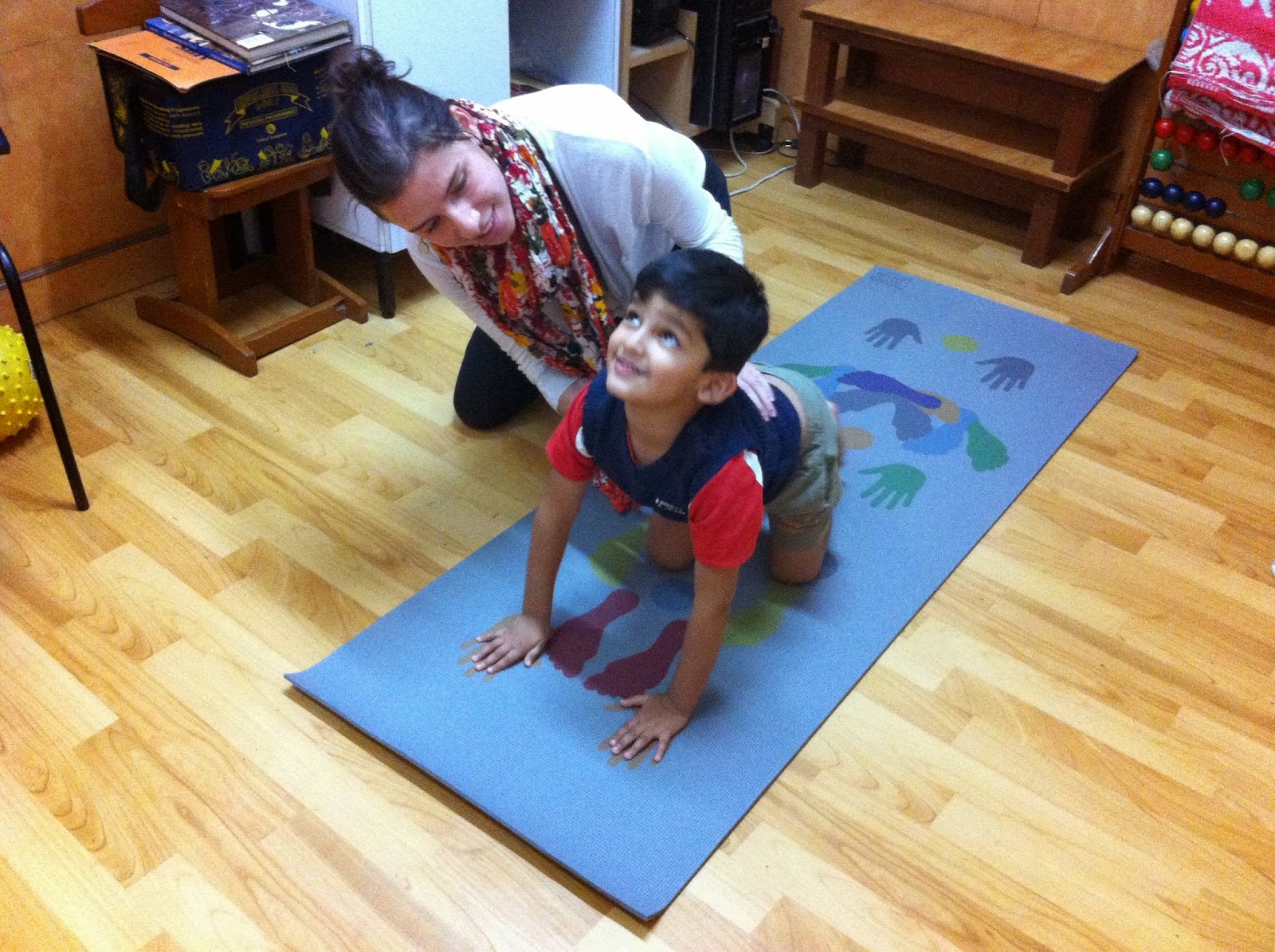
As an intern, I observed the work being done at the clinic, comparing it to the work being done in the US, finding that it is surprisingly very similar! All the same tests are used, just with slight cultural adjustments. I found that the yoga set was extremely helpful in occupational therapy as a way of practicing direction following, color recognition, turn taking and body awareness. The kids absolutely loved it as it was a great change from the normal routine. 


Stretch What Matters is honored to be part of CCDD - an organization making a powerful difference in the lives of children with special needs and their families.

To learn more about Stretch What Matters, visit www.stretchwhatmatters.com
To learn more about CCDD in Bangalore India, visit http://www.ccdd.in

Wednesday, July 16, 2014

Teacher Spotlight: How Jessica B. Brings Stretch What Matters to Life in Her Kindergarten Classroom

What prompted you to participate in the Stretch What Matters Level 1 yoga training?

I am a Kindergarten teacher and I have a background in dance and was hoping to expand my repertoire in terms of ways of meeting the needs of the diverse population one teaches in a public school setting.  I really believe in the mind-body connection and I thought, “what better way to reach kids than yoga?!” 

What did you take away most from the level 1 training?

Well, first of all, my hopes for the training were met and surpassed!  Elizabeth had a wonderful way of imparting knowledge and empowering the participants to find and share their own unique “gift” through the vehicle of yoga.  I also felt that this approach was feasible for many ages and populations and there were so many tangible, practical applications that I enjoyed trying out with my students almost immediately!  I loved that we practiced first as students, learning both the theory and then applying the practice with each other prior to attempting with our own students;  it made for a smooth and more confident transmission of knowledge and practice.  Even the smallest moments relating to breath and mindfulness became so powerful once I saw my students practicing it themselves!

What makes bringing yoga and mindfulness strategies to children a challenge, and how have you remedied it?

The challenge for my particular situation is the sheer class size, range of abilities and time constraints.  However, Elizabeth and the other participants all had wonderful ideas about how to cater or modify the practice to suit individual needs.  For example, one such activity was to pair a student whom might have a harder time breathing slowly with two others who are able to breath slowly and hold hands as they guide each other—something so simple yet incredibly helpful!  I also shifted my approach to fit my needs time-wise in that I use bits and pieces of the training throughout the day or week for smaller chunks of time rather than a “typical” full class period. 

How have you witnessed the benefits of sharing yoga and mindfulness with the children you teach?

I took this training toward the latter part of an academic school year and even in the relatively short amount of time in which I had to implement aspects of the training, I have seen students improve in terms of coping skills, relaxation techniques, and focus and attention.  There is also a clear correlation to motivation – kids simply love yoga and ask for it because it’s fun and it feels good to them!  Some of them even wrote about it as their favorite part of their school year J

How have you witnessed the benefits of yoga and mindfulness within yourself?

My overall patience, ability to be present in the moment and put all of life’s challenges in perspective has been the most apparent shift in my day-to-day life.  Just breathe…

About Jessica 
Jessica is a creative, inclusive and passionate kindergarten teacher for the Natick Public School System. She is the loving mother of her 2-year-old yogi (on the left) and she and her husband are excitedly awaiting the birth of their second child!


Elizabeth Goranson, M.S.Ed, RYT is the President of Stretch What Matters, LLC and the creator of the first visual yoga system. Elizabeth offers yoga and mindfulness programs for those with special needs. To learn more about her teacher trainings and patented yoga system, please visit: www.StretchWhatMatters.com

Follow us on Facebook


Upcoming Teacher Trainings:

October 18-20, 2014
Roots & Wings Yoga & Healing Arts Center, Natick, MA


Monday, February 17, 2014

What Does "Special" Really Mean?

I teach yoga and mindfulness to those with and without special needs. You get that, right? I thought I did too - until something that a yoga student said changed my mind.

I have been teaching and learning from children and young adults with and without special needs for over 15 years. When I left the classroom to begin Stretch What Matters, my mission seemed simple, "To enhance the quality of life, both mentally and physically, for all individuals regardless of age, ability or special needs through yoga."

Special is an interesting term and as I take a closer look at it, I begin to see how it can completely misrepresent an individual. The range of "special" is so great that instead of creating a consciousness of inclusivity, it creates one of exclusion. How does this affect what I do?  By creating classes for those with special needs and those without special needs, I strengthen the idea of separateness. When I separate students based on labels they have been given, I run into the problem of placing them into boxes with predetermined ceilings for growth. An interesting situation I have created for myself and those I teach . . . 

Recently, in a class I offer to 'mixed' teen girls, however the majority of whom are typically developing, a student's words reminded me that the time to lift the ceiling of what it means to be "special" is now.

At the start of class, I asked if anyone had any injuries I should be aware of. A few girls laughed and one of the laughing students admitted that she had injured herself right before class (she had slipped on some ice and had fallen pretty hard). As she quickly turned red, she placed a forced smile on her face, gave a thumbs up and announced to the class that she was, "special". I felt my breath stop and my throat tighten. There were girls in my class who had documentation to support just how special they were . . . did they feel those words?

After allowing what seemed like an awkward space of time pass, I found my breath, softened my gaze and listened for a loving response to reveal itself. What followed went something like this -

"You are special. I love that about you." 

I paused until I felt the student had heard my words. We made gentle eye contact and I witnessed her smile soften and her shoulders relax.


I continued to lovingly talk directly to the child although I knew our audience was much greater, in fact you could hear a pin drop. . .

"Your special decided to speak up today and share how you fell really hard in front of your friends. Your special was able laugh at yourself. Your special was able to pick yourself up in front of your friends and begin again. Your special is authentic and no one else's special looks like yours. Your special is a gift to you and to everyone around you." 


I paused.


As I scanned the room with my eyes, I saw and felt love looking back. 


Please do not misinterpret what I am saying - I understand that everyone has different abilities and that all of us sign up for classes we believe are most suitable for ourselves and our children (I take the process of grouping yoga students very seriously). For me personally, the moment in class encouraged me to examine something that has been stirring up in me for years. It is this idea that many people are unconsciously trained to place those with special needs into a "one size fits all" category. 


So what does "special" mean? At it's core, I believe special means the strength to be yourself in a world that often focuses on where you are not, special means knowing that you have something to teach the world, special means that your life has the power to transform others' lives, special means trusting that you are perfect and whole exactly as you are today and that your self growth is always - growing.


Here's to always looking under the label of "special"  and to honoring the gifts each of us are here to share. I found this video after completing this blog. Perfect timing. 


Elizabeth Goranson, M.S.Ed, RYT is the President of Stretch What Matters, LLC and the creator of the first visual yoga system. Elizabeth offers yoga and mindfulness programs for those with special needs. To learn more about her teacher trainings, patented yoga system and programs, please visit: www.StretchWhatMatters.com

Follow us on Facebook


Upcoming Teacher Trainings:

March 14-16, 2014 (FULL)Yoga Dimensions
Newtown, Ct
Newtown Training funded by Yoga Reaches Out for Newtown Community Members

April 11-13, 2014
Roots & Wings Yoga & Healing Arts Center, Natick, MA


Thursday, August 15, 2013

Stillness


I won't begin this newsletter by defining "stillness". Instead, I invite you to practice stillness for the next 3-minutes before continuing to read on. Simply relax your body into a comfortable position and follow your breath for 3-minutes (about 25-breaths).

How did that go for you?

My hypothesis suggests that many of you skipped over the stillness exercise. The fascinating thing is that our minds are excellent at reminding us that pausing for relaxation may actually induce more stress (please read that line again if it sounds confusing).

We have all been there at one time or another- when we have to choose to rest or not rest.  When we are being honest with ourselves, we can agree that life flows more easily when we make time for rest, stillness, meditation, yoga, fill in the blank . . . So who's voice is it that insists that studying an extra hour versus doing relaxation is more beneficial? Continue reading . . .

The voice is one that does not come from within us. It is a voice from outside of us reminding us that we must push harder in order to keep up and that rest equals falling behind. We all can hear the truth in this when we read it, yet the only way we can prove to ourselves and our children that doing relaxation is worth doing, is by believing that it is something that will improve all areas of our lives (including homework, school, friendships, sports, family relationships, this list is limitless).

What matters most is the voice that comes from within us - because our bodies never lie. When we are feeling tired, it is time to do relaxation. When we are feeling tight, it is time do relaxation. When we are feeling upset, it is time do relaxation. Here is the kicker - get ready, when we are feeling good, yes, it is time to do relaxation. Our bodies and our children's bodies will reach for healthy and supportive relaxation strategies when they practice relaxation - often.

Wishing you all a relaxing end of summer!

Click here to learn more about our Fall classes and the Stretch What Matters Level 1 Intensive Teacher Training.

Namaste,
Elizabeth


Tuesday, March 12, 2013

The Benefits of Yoga for Those With Special Needs

What comes to mind when you think of someone on the autism spectrum? As a culture, we often see the behaviors associated with a disorder like autism, and don’t bother looking past it.  We don’t see the child; we see our perceptions of his limitations. But in reality, these lowered expectations amount to a band-aid for unexpected behaviors, rather than a solution.

Meeting learners with autism with pity and personal frustration only lowers the bar for their greatest potential. I brought yoga into my classroom to teach my students, especially those with special needs, how to identify and manage their behavior. As a regular practitioner, I knew yoga supported individuals in coping with stress, managing reactions and emotions. I believed if yoga worked for me, the practice could help children, with autism or otherwise, learn to self regulate their behavior and mood, just like it helps the rest of us. But it’s not a one-size-fits-all practice.

Change the Approach


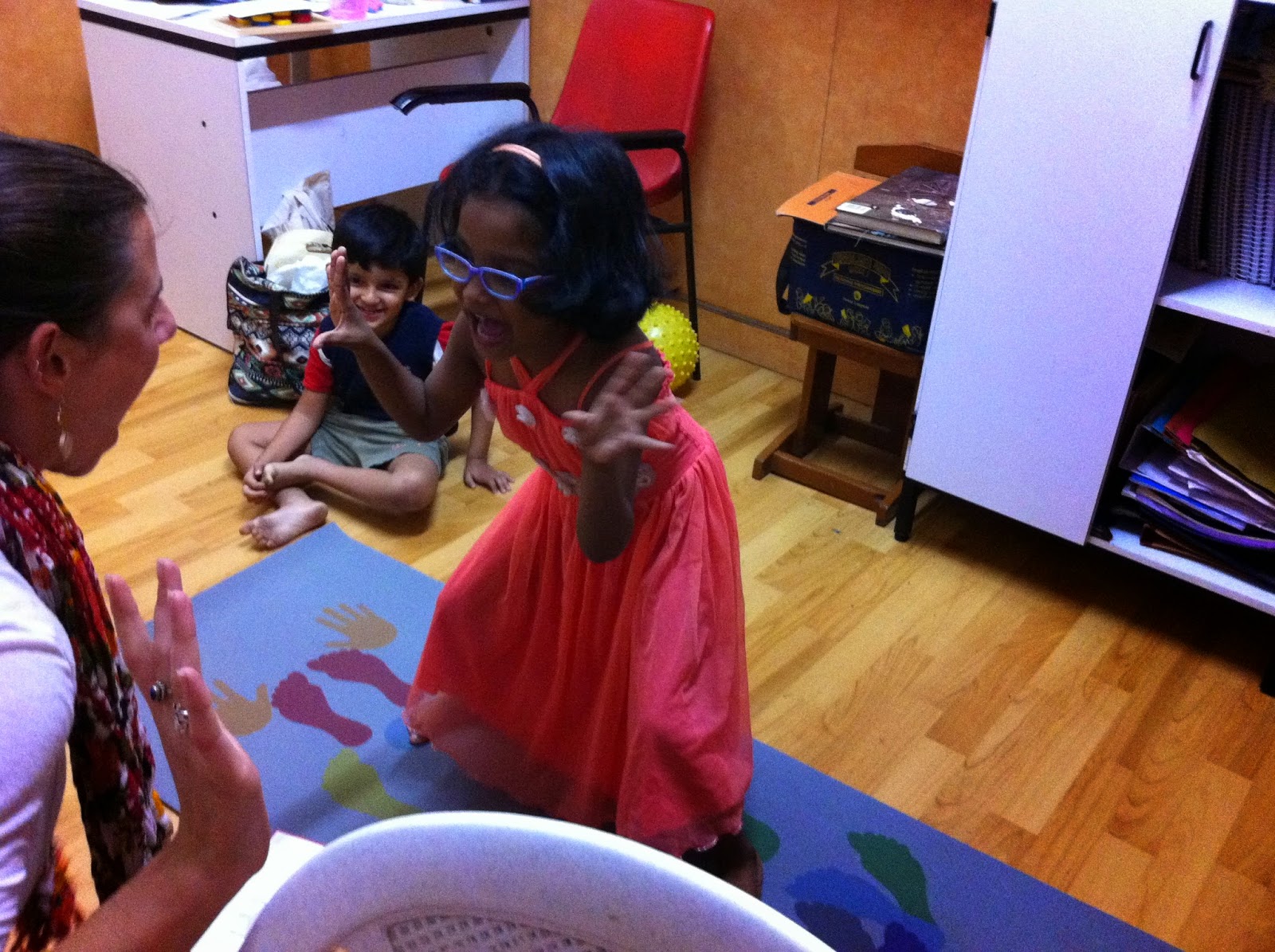
The first time I brought yoga mats into the classroom, some of my children with special needs didn’t understand that their mat was their space, their sacred space. Some people learn by hearing spoken cues. Some require visual cues to understand. It took some brightly colored paint, with footprints and handprints illustrating where to position their bodies, to have the message clearly received. Once my learners saw the whole picture, they began to understand the pieces of the practice. First the breathwork, then the physical postures, then relaxation, and ultimately more self-control and self-regulation. Over time, yoga began to offer balance to the physical, emotional and mental wellbeing of my students and it eventually became part of the daily schedule.

Traditional education is filled with wonderful lessons on mathematics, grammar, science and even anti-bullying - but not nearly enough lessons on what to do when one is struggling with math or when the bully shows up even after a lesson on "how to be a friend." The lessons yoga provides, on how to become aware of our thought patterns and stress triggers, allows children to begin to identify, manage and prevent stress on their own. 

We can empower students, with or without special needs, with yoga. As parents, teachers and yoga teachers, we need to learn how to meet kids where they are and trust that ALL children are capable of learning to find a place of calm within themselves – with individualized help. Isn’t that one of the primary lessons in the practice of yoga? Meet yourself and others where they are.


Yoga is a practice that opens doors for children with special needs. It parallels and supports other therapeutic modalities in addressing challenges with attention, self-regulation, speech and language, learning, and high and low muscle tone. Through yoga, children:
*Strengthen their core musculature: improving balance and endurance and allowing for deeper respiration.
*Balance their nervous system: bringing them out of fight or flight and into a place of relaxation.
*Support sensory processing: poses offer proprioceptive, vestibular and tactile input and aide in the development of gross motor skills.
*Enhance self-regulation: offers them the ability to control energy and activity level.
*Support sequencing and motor planning skills: they master directions for moving in and out of poses and memorize pose sequences. What they begin on the mat then moves into the rest of their life.
*Enhance speech and language abilities: yoga can release anxiety and tension helping to coordinate breathing and speech
*Promote over all physical fitness: yoga promotes strength, flexibility and balance.
~Namaste

Elizabeth


Friday, October 26, 2012

Who Drives Your Child to a Place of Calm?


Think about an instance when you had someone drive you to the same location several times.  The trip always felt familiar and it was nice to know that you could sit back and enjoy the ride.  Then one day, the driver invited you to take the wheel for a change - and something strange happened . . . you had absolutely no idea where to go.  Sound familiar?

Now think about you and your child . . . who is in the driver's seat when she becomes overwhelmed, stressed out, angry? If you answered, "you", than you can assume that your child is not clear on where to go when she is trying to get to a place of calm.  Eventually your child may begin to assume that she needs you for directions because you have not shown that you trust her to get herself to the destination safely (self-esteem building opportunity).

Driving directions are similar to the directions located in your brain needed to soothe yourself.  There is a clear beginning, middle and end.  With mindful planning and practice - the destination can always be Pleasantville.  If the directions to relaxation are created with your child’s best learning style in mind and traveled on over and over again, voila – your child will have a well-paved relaxation map in his brain.  On the other hand, whenever a child is in a state of fear and is offered a new set of directions each time . . . well, you see where this is going. . . In fact, the frontal lobe (the part of the brain that stores the relaxation strategy) is the most difficult to reach when feeling upset unless the roads are paved like the Mass Pike. So how do we help children create their own internal navigation system?

Step 1:  Begin by figuring out how your child learns new information.  For example, does he learn visually (through pictures/written words), auditorily (through spoken language, music), or through touch (physical movement). You know your child better than anyone else, so pick the best avenue (sometimes it’s a combination of all three roads) and get ready to pave the road to peace together.

Step 2:  Create an easy to follow pathway to relaxation.  I have included one here for you.  This is one that I use over and over again with my own children.  I also practice this one on myself in front of my children (because children do as the see, right?)

Path to relaxation:
1.  Your child becomes upset (he doesn’t want to enter the classroom, he falls down, he makes a transition, he is worried about an upcoming test).

2.  Your child notices his heartbeat (fast rate). Instruct the child how to identify his heartbeat in his body by placing your hand over his hand over his heart.  Identify his heartbeat out loud and paired with the feeling: “You are feeling __________ and your heart is beating fast.”

3.  Invite your child to think of a calming color or choose a color for her. I have found blue to be most commonly chosen.

4.  Instruct and model for your child to breathe the calming color he has chosen in and out of his belly. Teach belly breathing by placing his hand on his belly and watching/feeling his belly grow as he breathes his color in and shrink as he breathes his color out.  For children who have a challenge with breath control, physically guide children to raise their arms on the inhale and lower their arms on the exhale.  Some children do well with the cue, "Smell the flower, blow out the candle." Continue this breath for 3-10 breaths.

5.  Return to the heart beat and notice it beginning to slow down. If necessary, show the child how to feel her heartbeat in her body slowing down by placing your hand over her hand over her heart.  Then identify her heartbeat out loud.  “You are safe and your heart is slowing down.”

For the Visual Learner:  Draw an illustrated story of these steps to review and practice with your child.  Make copies of it and carry it with you, hang it in the relaxation space of your home, keep it in your car, etc.

For the Tactile Learner:  Place your hand over your child’s hand on your child’s heart (notice change in heartbeat throughout calming process).  Same for belly breathing: place your hand over your child’s hand on your child’s belly.  You may also hug your child and allow her to mirror your belly breathing. Their breath will sync with your breath over time.

For the Auditory Learner:  With a soft, calm and nurturing voice, say something like:  “You’re feeling __________ (name the feeling) and your heart is beating fast.  Breath in the color blue to your belly, breathe out the color blue (make your breath audible).  “Your heartbeat is slowing down.  You are calming your self down.  You are safe and calm.”

Things to keep in mind:

• The strategies above acknowledge that your child is feeling something.  Often, as parents, we try to push a feeling away by saying things such as, “You’re okay,” “Don’t cry,” “It’s just a scratch.”  Our intentions are good—we don’t want our children to feel upset. However to be more effective and empowering, we want to encourage our children to practice identifying negative feelings in their bodies and calming themselves down as these feelings arise.  As children grow older, negative feelings can become bigger and last longer if they are not taught how to be identified and managed.

• Your relaxation path must be practiced when your child is calm in order to be successful when he is not calm (think bedtime routine or after school).  Remember the frontal lobe mentioned earlier?  Your child paves the relaxation strategy over and over again when he is calm in order to easily access it whenever he is in a state of fear.

• There is always time for a relaxation path strategy such as this one. With practice, this tool will become a part of you and your child’s life.  In time you won’t think twice about holding up the grocery line, the nurse, the doctor, or the teacher to implement this path to relaxation.

Lastly, keep it simple, keep it consistent and keep it calm.  To learn more about Elizabeth’s offerings . . . 

Sunday, August 26, 2012

Staples Thinks, "It's The Most Wonderful Time of The Year!" . . . Really?


Children of all ages are days away from returning to school and many of them will be carrying more than just new backpacks. Swirling emotions surrounding teachers, homework, classroom assignments, friendships and even locker combinations- are weighing down on what I call the "emotional back pack". To make things heavier, parents attempt to "share the load" by carrying their child's bag as well as their own - yes, parents have their own backpacks filled with good intentioned yet un-serving thoughts.  Such as, "What if my child's teacher puts a halt on her creative thinking?  What if my child is bullied?  What if my child's teacher doesn't understand my son's special needs? What if my child __________?  Do you see where this list is going?  If you said, "Nowhere." - you are incorrect but not to worry, I am not passing out grades today. 

In reality, negative thoughts about school are unproven ideas about the future (aka fear) that have the power to attack one's immune system, sleeping patterns, appetite, the ability to learn and even relationships with others. That's right, negatively charged thoughts send out a "not so good vibe"  to those we love. Okay, enough with the not so positive back to school progress report. You get the lesson, right?

So how do we lighten our backpacks? The answer is yoga and meditation (I'm guessing you're not too surprised).  As scientific research reveals, when you turn inward, your breathing slows, blood pressure decreases, and stress hormone levels fall. More important, through daily practice, you and your child have the power to quiet your minds and identify your emotional backpacks as thoughts - not reality (instant freedom, right?). 

As a gift, I am sharing my favorite and most frequently used guided meditation for you to begin with your family (my yoga students love this one!) see below this post for the guided meditation.

To lighten your backpacks further, please take a look at our fall offerings and remember -  freedom is just a breath away.  

Wishing you a peaceful start to your school year!

Namaste,

Elizabeth

 
Family Guided Meditation
By:  Elizabeth Goranson 

  1. Create a space in your home where meditation will take place (a corner in your favorite room, a cozy closet or even under a table – yes, I have seen this work!).  I encourage you to turn the space into place of calm by adding a pillow, a special object such as a seashell from a special trip or a flame-free glowing candle.
  2. Figure out the best time of the day to practice meditation (3-10 minutes).  For some it is first thing in the morning and for others it is after school, before homework or right before bed.  Whatever works, build it into your family routine just like brushing teeth – a healthy mind can get a good cleaning everyday too, right? 
  3. Establish a comfortable meditation posture.  Maybe you sit in criss-cross yoga sauce pose side by side or perhaps a little one sits on your lap to share the rhythm of your breathing and heart rate.  
  4. A visual timer in the beginning may be helpful for young children and may prevent them from asking, “How much longer do we have to be calm?” 
  5. Begin the meditation by guiding your child with the following directions.  Be sure to perform the meditation yourself.  Children learn best by watching their caregivers.  I included modifications for individuals needing alternative directions. 
  • Close your eyes (or keep them open and place your gaze on a candle or other object. 
  • Notice the noises around you. To modify label the noises you hear nearby and in the distance. (4 seconds) 
  • Notice your heartbeat.  To modify, place your child’s hand on his heart. (4 seconds) 
  • Notice your breath. (4 seconds)  To modify, make your breathing audible for your child to hear. 
  • Begin inviting your child to squeeze and relax each part of his body beginning with his feet and working up towards the crown of his head.  Modify this by physically squeezing and relaxing your child’s body as you call out parts:  squeeze your feet/relax your feet, squeeze your legs/relax your legs, squeeze your stomach/relax your stomach ect.).  I love this body scan because it gives your family members an understanding of the word “relax”. 
  • End meditation here or continue with color breathing . . . 
  • Think of a color that is ________ (relaxing, strong, brave, confident).  Modify this by suggesting a color.
  • Breathe the color into your stomach; breathe out the color into the room (or share your color with a family member).  Modify by placing your hand on child’s stomach and feel it rise and fall or invite your child to feel your stomach rise and fall with your breathe. 
  • Continue color breathing for 5-10 breaths. 
  • For older children (5 and up) dedicate the time spent meditating to someone in your family. 
  • Open your eyes and enjoy a peaceful hug.  Small children enjoy guessing each other’s color. 

Saturday, November 19, 2011

Turn Up the Silence

I eagerly greeted my yoga student (whom I will give the name Carrie for this piece) at the door of the yoga studio.  A teenager on the autism spectrum, I hear from her parents that yoga is one of the activities she runs out of the house to attend weekly (we have this in common).

Carrie is verbal, however her expressive language is limited.  She responds well to yes/no questions and prefers verbal choices when responding to questions with multiple answers.

“Hi Carrie!”

“Hi Elizabeth.”

“It is so nice to see you Carrie!”

Carrie offers me a huge smile with a thumbs up.

Upon entering the studio, Carrie quickly takes her socks off and finds a comfortable seated position on her brightly colored-coded yoga mat.

After practicing with me for 1.5 years, Carrie knows the yoga routine by heart but still finds comfort in seeing the visual yoga schedule.  I enthusiastically pick up the clip board and say, "Let’s review the yoga schedule!”  Carrie, still smiling, nods her head yes! rapidly up and down.

1.  Check-in
2.  Breathe
3.  Sun Salutations
4.  Yoga Pose Cards
5.  Head massage, hand massage, foot massage, squeeze and relax
6.  Savasana

As a Special Educator for the past 15 years, I make strong attempts to pair visual information with verbal cues.  My intention is to strengthen my learners’ receptive and expressive language skills.  Research supports this strategy – ask any speech therapist.  Lucky for me, I love talking . . . ask anyone who knows me.  Luckily for Carrie, I realized that she no longer needed me to make my visual cues audible.

Something powerful washed over me this past Thursday while we practiced yoga together.  My verbal cues to breathe in and breathe out were gracefully silenced by Carrie’s ability to breathe deeply on her own.

I realized her breaths were long and slow.
I realized her nostrils and abdomen were opening to the song of her own life force.
I realized she was there and now so too was I.
I noticed that the colorful visual yoga system spoke to Carrie's mind and body clearly.
I noticed how hard it was for me keep quite.
I noticed how I felt like I was getting paid for doing nothing.
I noticed how Carrie’s repetitive self-talk disappeared.
I noticed when Carrie whispered “Peace” on the inhale and “Love” on the exhale during savasana -   something I had taught her but failed to hear during many of those Thursday afternoons together.

I noticed how beautiful it felt to let Carrie be herself.

Silence never felt so good.

Saturday, April 16, 2011

Dedication

I was introduced to Billy Megargel in 1999.  He was a young boy with Autism and I was a young teacher with much to learn.  I began working with individuals with Autism Spectrum Disorders right out of college in 1997.  I was convinced back then that working with those with special needs was going to be part of my life's work.

Billy would change the way I interact with all individuals with special needs and for that I am eternally grateful.

Billy is nonverbal and uses an augmentative communication device to communicate with others.  Talk about judging a book by its cover . . . he let me know from day one, that his ability to navigate his way through his device far outweighed my expectations of him.   Interestingly enough, every time I raised my expectations for Billy- I learned that my bar needed to be raised again, and again, and again.  This is an interesting practice to try on yourself . . . just a thought.

Over the nine years I worked with Billy and his family, my teaching skills with all learners changed.  Billy taught me that when a child didn't understand a concept I was teaching, that teaching it a second time with a louder voice was not the answer.  Billy taught me that "individualized" means understanding how a person optimally receives and expresses information.  Billy taught me that everyone is capable of learning and growing towards greater independence every day.  He was my "wake up call" to teaching.

Billy was introduced to yoga several years ago.  Eve, Billy's Mom, a consistent practitioner of yoga and Billy's greatest advocate (right next to his Dad, Matt), believed that Billy was entitled to learning yoga.  Her intention was for her son to use yoga as a means of regulating himself.  Up until that point, Billy's request for a "break" entailed him entering a comfortable area to relax and breathe for a designated number of minutes.  As Billy grew older, Eve intuitively knew that her son needed to learn what "relax" meant.  She knew that he would benefit from something physical and organizing to his entire body - both during times of peace and stress . . . yoga seemed like the natural next step.

Billy's Mom and yoga instructor, Hannah Gould, created a sequential visual system with photographs of yoga poses that would be optimal for Billy's learning style.  Billy took to his yoga practice beautifully, and it clearly became a prefered activity for him.

For a few years, Billy's health took a very serious turn for the worse. For weeks at a time, in between hospitalizations, he would rest in his darkened bedroom.  When everything had turned upside down for Bill and his body - and all activities were taken off of his daily schedule, yoga was the one choice that  always was there for him.  Yoga was Billy's blanket of peace time and time again.

Billy's yoga practice inspired me to rethink the way I taught my learners to balance themselves.  After taking a closer look, I learned I was regulating my students as opposed to offering my students tools to regulate themselves.  It is one thing to teach someone how to request a break.  It is by far something very different to teach someone how to successfully take a break. Think about that for a moment.  How often do we tell children to take a break or a time-out without showing them them how to relax themselves?     When was the last time you allowed someone you know to feel upset and then offered them, some steps they could take to feel calm again? When was the last time you felt upset and what were the steps you took to feeling at peace with yourself and the situation?  Learning and teaching how to find that place of calm takes time - but it is worth every second.

Billy taught me that taking the time to teach myself, my students and my own children how to find internal balance - is more important than any other life skill.

Thank you Billy.

Thank you Eve for encouraging me to think outside of the box with all of my students.  Your unbelievable commitment to Billy's path as a life long learner, reminds me to always get out of my own head and into the minds and hearts of my students and my own children.

Stretch What Matters Yoga System:


Dedicated to Billy Megargel, 
my longtime student and greatest teacher.


Tuesday, November 23, 2010

GRATEFUL

I practiced yoga today with my 4 year old son, Christian, on the first manufactured toddler mat.  When I rolled the mat out in front of him, his big brown eyes opened wide as he carefully scanned the mat.  He quickly realized his mat was different as he compared his little mat to my large mat.  He said, "My mat is NEW!"  I responded with laughter, "Yes, your mat is brand new!" Christian and I then practiced a few poses together on our mats - he loves to be the yoga teacher!

A few hours later, I sat down with my two children to eat dinner.  Before dinner in our home, we all hold hands and take turns saying one thing we are grateful for that day. My son tends to list 10 things a day but no one ever stops him.  He often is thankful for his best friend, Canyon and sometimes, if I behaved like a super hero, I make it onto my son's list.  Tonight however was special . . . Christian sat up tall in his seat and said with a smile, "I am thankful for my yoga mat because I like doing yoga with Mommy."

Friday, September 17, 2010

Launching a Dream

Just one year ago this month, I saw in my mind's eye, a yoga mat that would allow individuals with special needs to practice yoga.  I had been teaching yoga to individuals with special needs for quite some time and I often struggled with successfully cuing my students on how to transition from one pose to another.  I found myself on my students' yoga mats most of the time and this went against everything I hoped to give each of my students - independence.  If my goal was to teach people to use yoga to regulate themselves, how in the world were they going to do it on their own if I was always physically showing them what to do?

That is where THE MAT comes in.  After I saw the picture of the yoga mat in my mind (which I refer to as divine intervention), I quickly placed my then 1 year old daughter, Gracie, in her crib for the night. I instantly began sketching the yoga mat on sheets of paper using my son, Christian's, crayola crayons.  The more I drew the more I thought, this mat must already exist.  So I simply began searching for the mat online.  To tell you the truth, buying the mat last September would have been a heck of a lot easier than the road I have traveled on to bring my mat to life - but I would not give that journey up for anything.

After sharing the idea with my husband, Scott (thank God for you), I shared the idea with my mom. I asked her to sign my 'inventor's notebook' that I had started shortly after I realized the product was not available.  I recall asking her to drive with me to the paint store so that she could sit with my children in the car while I found paints that would make up the first prototype of my mat.

So here we are.  September 18, 2010.  I say 'we' because I did not do this alone.  My team of angels all showed up at just the right time and for all of them I am beyond grateful.

Stretch What Matters most to you and see what happens!

Namaste,

Elizabeth